How Hartz AI Delivers Each Stage of the AI-Native Roadmap
Feeling overwhelmed by AI advice that doesn't fit your business? We get it. Our methodology was built for teams who want practical results, not PowerPoint decks and jargon.
Hartz AI follows one adoption model, the AI-Native Roadmap: Preparation, three build phases and managing AI over time. Every stage is delivered the same way, as discovery, pilot and scale, and transfers knowledge to your team. Over 500 professionals trained, 85% of clients operating independently within 12 months.
How does Hartz AI approach AI implementation?
Hartz AI approaches AI implementation through one model, the AI-Native Roadmap: five stages from preparation to managing AI over time, each delivered as discovery, pilot and scale. Craig Hartzel designed the approach specifically for UK SMEs because most AI consultancy firms use enterprise playbooks that ignore the realities of smaller teams and tighter budgets.
Each stage delivers standalone value. You can start with a workshop and stop there, or continue through to full implementation. There is no lock-in, no minimum contract and no dependency by design. The approach works because it builds your team's confidence and skills at every step.
What does Hartz AI do at each stage of the AI-Native Roadmap?
Preparation
We find out where you are now: processes, data, culture and an AI readiness audit, so the first workflow is chosen on evidence.
Phase 1: AI assistants
We put AI assistants into each team, connected to the tools you already use, and train people to use them well. A person checks every output.
Phase 2: Department brains
We build a department brain over your own documents and records, with access limited to the people who already see that data.
Phase 3: Agents and orchestration
We add agents for multi-step work inside one department, coordinated by an orchestrator agent. People keep every key decision.
Managing AI over time
We hand over documentation, training materials and an operating guide, then help you review what is used and what to retire.
Every stage is delivered the same way: discovery, pilot, scale. Discovery picks a small set of workflows and agrees how success will be measured, the pilot proves them with real users against that measure and scale extends what worked to the rest of the team.
The four steps follow the AI-Native Roadmap: assess and plan are its Preparation stage, build covers Phases 1 to 3 (each delivered as discovery, pilot and scale) and sustain is managing AI over time.
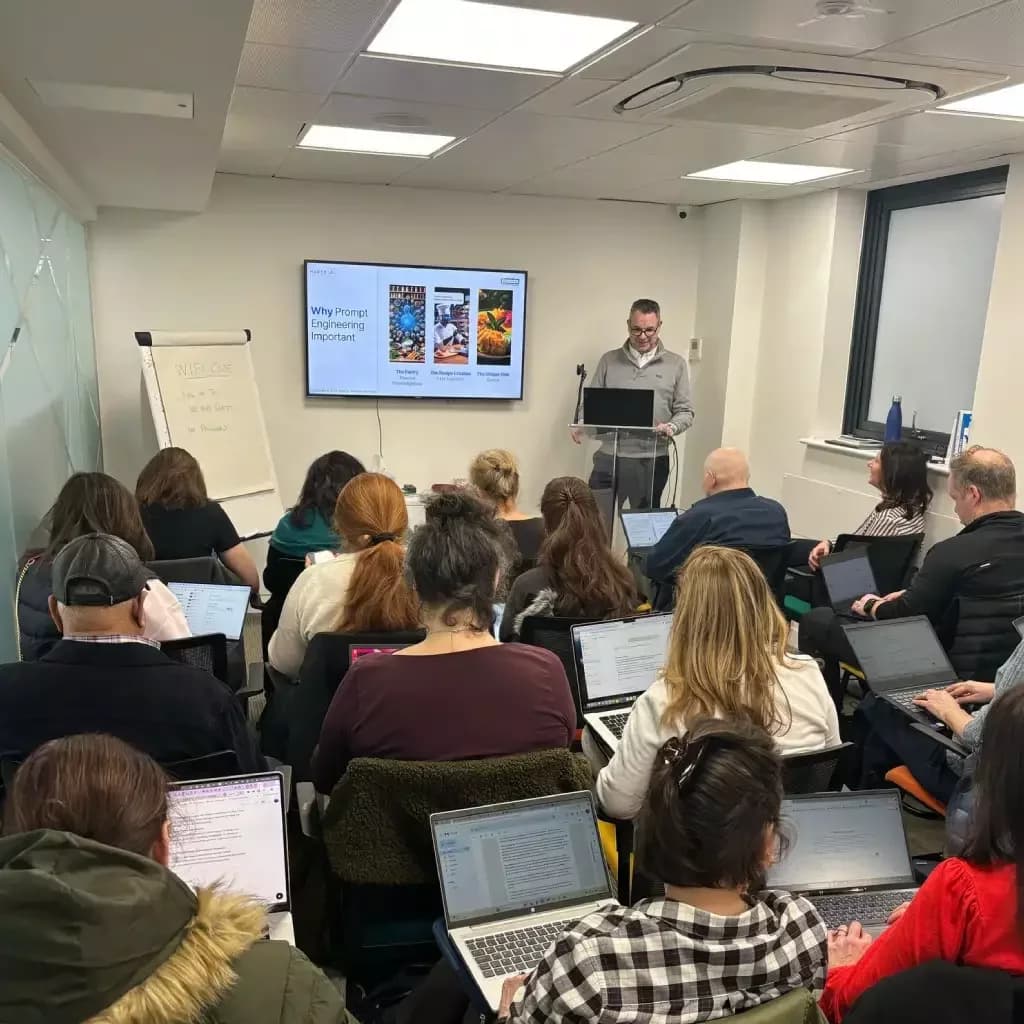
Training runs alongside every stage, so your team develops real skills as the work changes. Our AI training programmes for UK teams are designed to work alongside each implementation, so your people build confidence while the technology is being embedded.
Why does this approach work for SMEs?
Most AI methodologies are designed for enterprises with dedicated data teams and six-figure budgets. They do not work for a 30-person professional services firm or a charity with limited IT resource. Hartz AI's methodology was built for exactly these organisations.
Each stage is designed to produce immediate, usable results. After Preparation, your team already has a clearer picture of where AI fits and a first workflow worth trying. After a Phase 1 pilot, you have measured results you can act on with our AI implementation services or on your own. No stage requires you to commit to the next.
Research published by the Department for Digital, Culture, Media and Sport in 2022 on AI activity in UK businesses found that limited in-house skills and a poor understanding of where AI applies are among the main barriers for smaller firms. Our approach addresses this by teaching before building.
The OECD's 2024 Generative AI and the SME Workforce report reinforces this finding: only 31% of SMEs across surveyed countries have adopted generative AI, with skills gaps and a lack of structured guidance cited as primary barriers. A capability-first approach addresses both.
The UK Government reaches a similar conclusion in its AI Opportunities Action Plan, which sets out skills and adoption support as national priorities for spreading AI use beyond the largest organisations.
What principles guide the Hartz AI methodology?
BCG's global survey of 1,000 senior executives found that 74% of companies struggle to achieve and scale value from AI (October 2024). The leaders put 10% of their resources into algorithms and 20% into technology and data, with 70% going to people and processes. Our principles follow the same balance: most of the work is with your people.
Capability over dependency
Every engagement is designed to transfer knowledge. We train your team to lead AI initiatives independently, not to rely on consultants indefinitely.
Plain English, always
Craig Hartzel founded Hartz AI with a commitment to clarity. We explain every concept in language your whole team can follow, from the board to the front line.
Evidence before action
We measure before we pilot and pilot before we scale. Every recommendation is backed by data from your business, not generic AI hype.
Responsible by default
AI governance and compliance are considered from the start of every engagement, not bolted on at the end, following the ICO's guidance on AI and data protection. Where an engagement includes governance work, it is led by Rivka Abecasis, Consulting AI and Data Governance Lead.
Common questions
Questions about the Hartz AI methodology
Start here
See how our approach works in practice
Book a free 15-minute discovery call. We will listen to where you are now, suggest a starting point and answer your questions. No pitch, no pressure, no obligation.
We'll come back to you within one working day.
Use the call to explore ideas safely, with no commitment.
Leave with at least one concrete next step.