AI Champions: Internal Leaders Who Drive Adoption
Most AI training ends with enthusiasm but no lasting change. An AI champion programme creates the internal leadership that turns one-off workshops into sustained, organisation-wide adoption.
UK Government research (opens in a new tab) found that only 15% of UK businesses have adopted at least one AI technology, with skills gaps cited as the primary barrier. Hartz AI champion programmes close this gap by building internal AI expertise that lasts beyond any single training event.
An AI champion programme builds internal AI expertise so your organisation drives AI adoption independently. UK Government data shows only 15% of businesses have adopted AI, with skills gaps as the primary barrier. Champions train for 12 weeks then mentor colleagues — reducing consultant dependency and creating a self-sustaining AI centre of excellence. A cohort is from £12,500 + VAT.
What Is an AI Champion Programme?
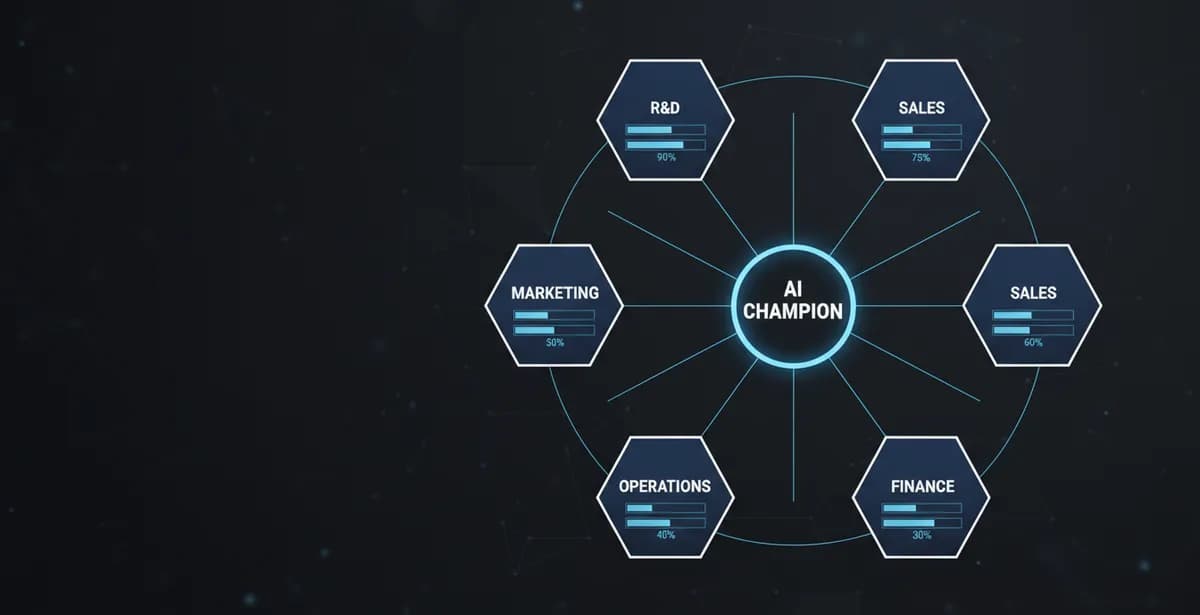
An AI champion programme identifies and trains selected employees to become your organisation's internal AI advocates. These are not IT specialists. They are respected team members from across departments who learn AI tools, develop use cases and then help colleagues adopt AI in their own roles. After completing team AI training programmes, champions become the bridge between formal training and everyday practice.
The Role of AI Champions in the Workplace
AI champions in the workplace have three core responsibilities. First, they identify practical AI applications within their department — spotting tasks where AI saves time, improves quality or reduces errors. Second, they support colleagues who are uncertain about AI, answering questions and running informal demonstrations. Third, they feed insights back to leadership about what is working and where the organisation needs additional support.
CIPD research (opens in a new tab) shows that 72% of employers cite skills gaps as a barrier to adopting new technology. Champions address this by making AI use safe and normal — reducing what researchers call 'AI shame', the reluctance to admit you do not understand how to use a tool.
How Champions Differ from IT Support
IT support fixes technical problems. Champions solve adoption problems. An AI readiness assessment for UK organisations typically reveals that the biggest barrier to AI adoption is not technical — it is behavioural. Staff know the tools exist but lack confidence, permission or motivation to use them. Champions provide the peer-level encouragement and practical guidance that no IT helpdesk or external consultant can replicate at scale.
Why Internal AI Champions Beat External Dependency
Every organisation needs an internal AI expert who understands both the tools and the culture. External consultants deliver expertise on a project basis — when the project ends, the expertise leaves. Internal champions help you reduce AI consultant dependency by keeping capability growing after the consultants have gone.
The Problem with Consultant Dependency
Consultant dependency creates three risks. Knowledge does not transfer — staff follow recommendations without understanding the reasoning. Costs accumulate with every new initiative requiring external support. And the organisation never builds the muscle memory to adopt AI independently. McKinsey research (opens in a new tab) found that organisations with dedicated internal AI roles are 1.6 times more likely to achieve meaningful AI adoption.
Consultancy Fees Versus a One-Off Programme
External AI consultancy is priced per engagement, so every new initiative reopens the cost. A Hartz AI champion programme is from £12,500 + VAT for a cohort, and the capability stays with your staff afterwards. 85% of clients are self-sufficient in AI within 12 months (Hartz AI client outcomes).
The national picture points the same way. The UK Government's AI Opportunities Action Plan (opens in a new tab) identifies AI skills shortages as a constraint on adoption and recommends building domestic capability rather than buying it in repeatedly. What is true for the country is true for a 50-person business.
‘Around 15% of all businesses have adopted at least one AI technology, which translates to 432,000 companies.’
How to Build Internal AI Capability
AI champions break the dependency cycle. They learn not just how to use AI tools but why specific approaches work. They develop the ability to evaluate new tools, design workflows and train others. Over 12 months, an organisation with three active champions can build internal AI capability that would otherwise require quarterly consultant engagements. For organisations that want interim AI leadership during the transition, a fractional Chief AI Officer to guide the transition provides strategic oversight while champions build ground-level capability.
Building Your AI Champion Programme: A Practical Framework
A successful AI champion programme follows a methodical design process. This AI skills development programme draws on implementation patterns tested across UK SMEs, with an architecture designed to produce measurable outcomes at each stage.
Selection: Choosing the Right Champions
How many AI champions does an organisation need? A practical ratio is one champion per 15-20 employees. For a 50-person organisation, that means 3 champions across different departments. The selection criteria matter more than technical skill. Look for curiosity, peer influence and willingness to experiment. The best champions are not always the most technical staff — they are the ones colleagues already ask for help.
The 12-Week Programme Structure
The programme runs in three phases. Weeks 1-4 (Learning): champions complete intensive AI training covering tools, prompt engineering, governance and use case identification. Weeks 5-8 (Applying): champions develop and test AI workflows within their own departments, documenting outcomes. Weeks 9-12 (Mentoring): champions begin training colleagues, running demonstrations and collecting adoption data. Each phase includes assessment checkpoints — this is not a self-paced course but a coached skills development programme with measurable milestones.
Tools and Resources Champions Need
Champions need three categories of support. First, a curated toolkit: approved AI tools with clear usage policies. Second, a prompt library: tested templates for common tasks in their department. Third, a reporting framework: simple metrics to track adoption and time saved. These resources reduce the friction between 'trained' and 'active' — the gap where most AI initiatives stall.
Free material has a place alongside all of this. Microsoft Learn's free training paths (opens in a new tab) cover tool mechanics at no cost, and champions can work through them for baseline knowledge before a coached cohort applies those tools to your own workflows and data rules. If you want a structured route through the material, our AI learning paths show what champions should study first.
From AI Champions to AI Centre of Excellence
An AI champion programme is the starting point. An AI centre of excellence is the destination — a cross-functional group that sets standards, shares best practices and coordinates AI initiatives across the organisation. Champions evolve naturally into this structure as adoption matures.
Measuring Champion Impact
Track four metrics quarterly. Adoption rate: the percentage of staff using AI tools at least weekly. Time recovered: hours saved per department per month. Use cases deployed: the number of documented AI workflows in active use. Peer training sessions: how many colleagues each champion has supported. These metrics make the programme's value visible to leadership and justify continued investment. Most organisations see measurable results within 90 days of launching their champion programme.
Confidence is the metric leaders underrate. Across Hartz AI programmes, participants report a 90% confidence increase post-training (Hartz AI post-training surveys), and confident staff are the ones who keep using a tool after the trainer leaves.
Scaling from Champions to Organisation-Wide Adoption
Champions are the catalyst, not the end state. After the initial 12-week programme, scale by training a second cohort — selected by the first cohort based on departmental need. Within 12 months, the champion network should cover every department, forming your AI centre of excellence. For organisations ready to formalise their AI policies alongside adoption, AI governance to formalise your AI policies ensures that your centre of excellence aligns with compliance requirements.
Common questions
Frequently Asked Questions
Take the Next Step
Your organisation’s AI adoption should not depend on consultants or the enthusiasm of a single employee. A programme design consultation assesses your current capability, identifies champion candidates and maps a 12-week programme to your specific sector and team structure.